Cable Science.
What an audio cable can change, what it cannot, and how geometry, shielding, capacitance, resistance and termination decide whether a cable is right for the job.
A cable should preserve the signal—not rewrite the music.
A well-designed audio cable is a controlled electrical path. Its job is to move a signal or power from one device to another while adding as little noise, loss, instability and mechanical trouble as practical. It does not create detail that was never recorded. It can, however, prevent avoidable resistance, capacitive loading, electromagnetic pickup, intermittent contacts and impedance mismatch from getting in the way.
That distinction is central to WBC engineering. We choose a construction for the application: coaxial geometry for unbalanced lines, impedance-balanced pairs or star quad for professional analog, heavy conductors for speakers, and controlled characteristic impedance for digital audio. Then we finish the assembly with connectors, soldering, strain relief and inspection suited to the real world.
Resistance
Turns conductor length and area into small voltage and power losses. It matters most in speaker cables.
Capacitance
Exists between conductors. It matters especially with passive guitar pickups and very long analog runs.
Inductance
Comes from loop geometry. In speaker cables, low and stable inductance helps keep the load predictable.
Coaxial RCA: one signal, one shielded return.
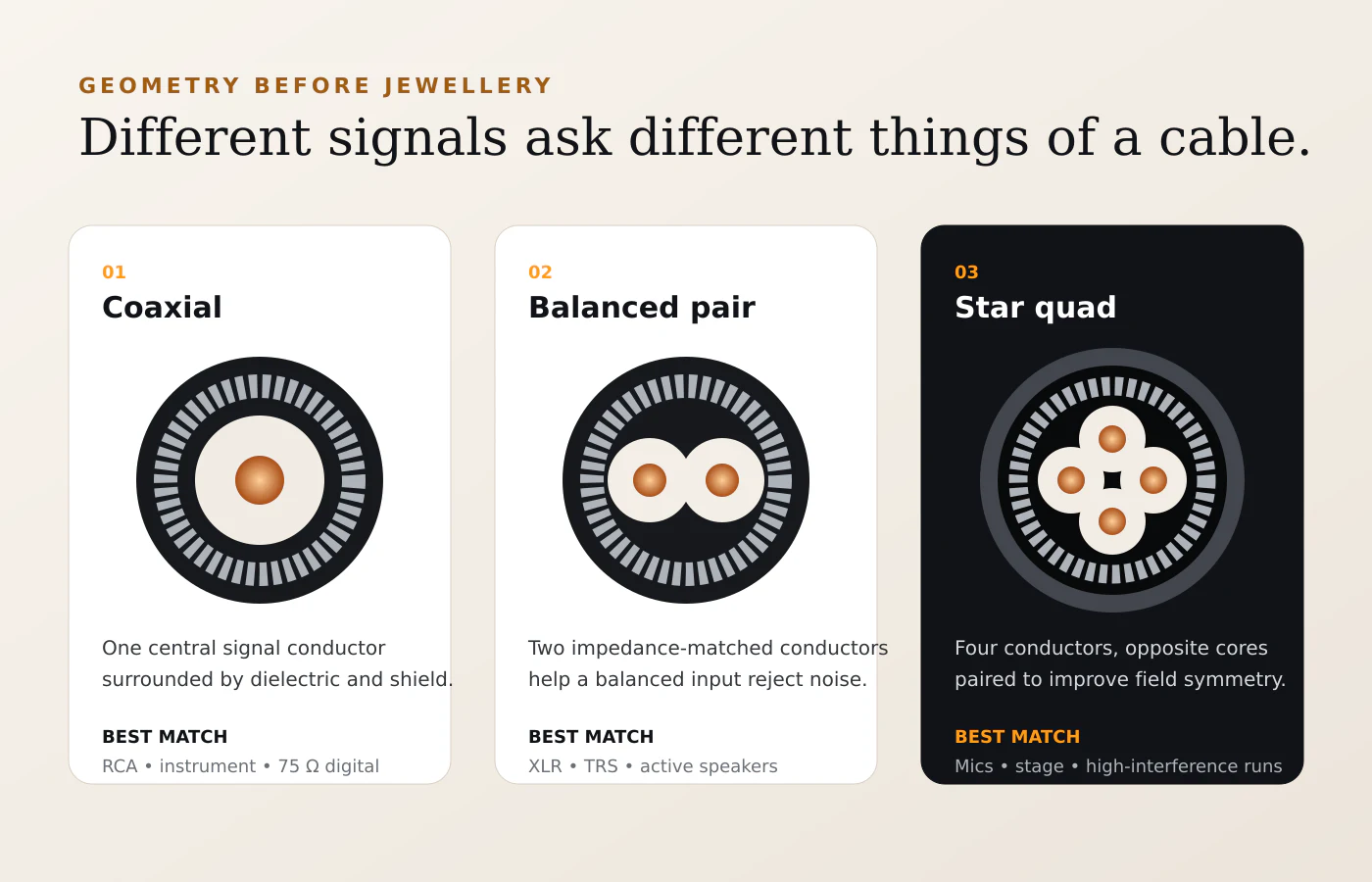
In a coaxial cable, the center conductor carries the signal while the surrounding shield provides the return path and helps block electric-field interference. The dielectric fixes the spacing between them, which largely determines cable capacitance.
For typical low-impedance hi-fi components, a properly built RCA interconnect is usually electrically transparent over sensible lengths. Low capacitance supplies extra margin, while dense shielding and dependable connectors address the more common enemies: hum, radio-frequency pickup and poor contact.
WBC-PRO-LOCAP coaxial RCA
WBC’s low-capacitance coaxial RCA assembly is the practical, professional-grade choice for DACs, preamps, integrated amplifiers, powered speakers and other line-level connections.
View WBC coaxial RCA ↗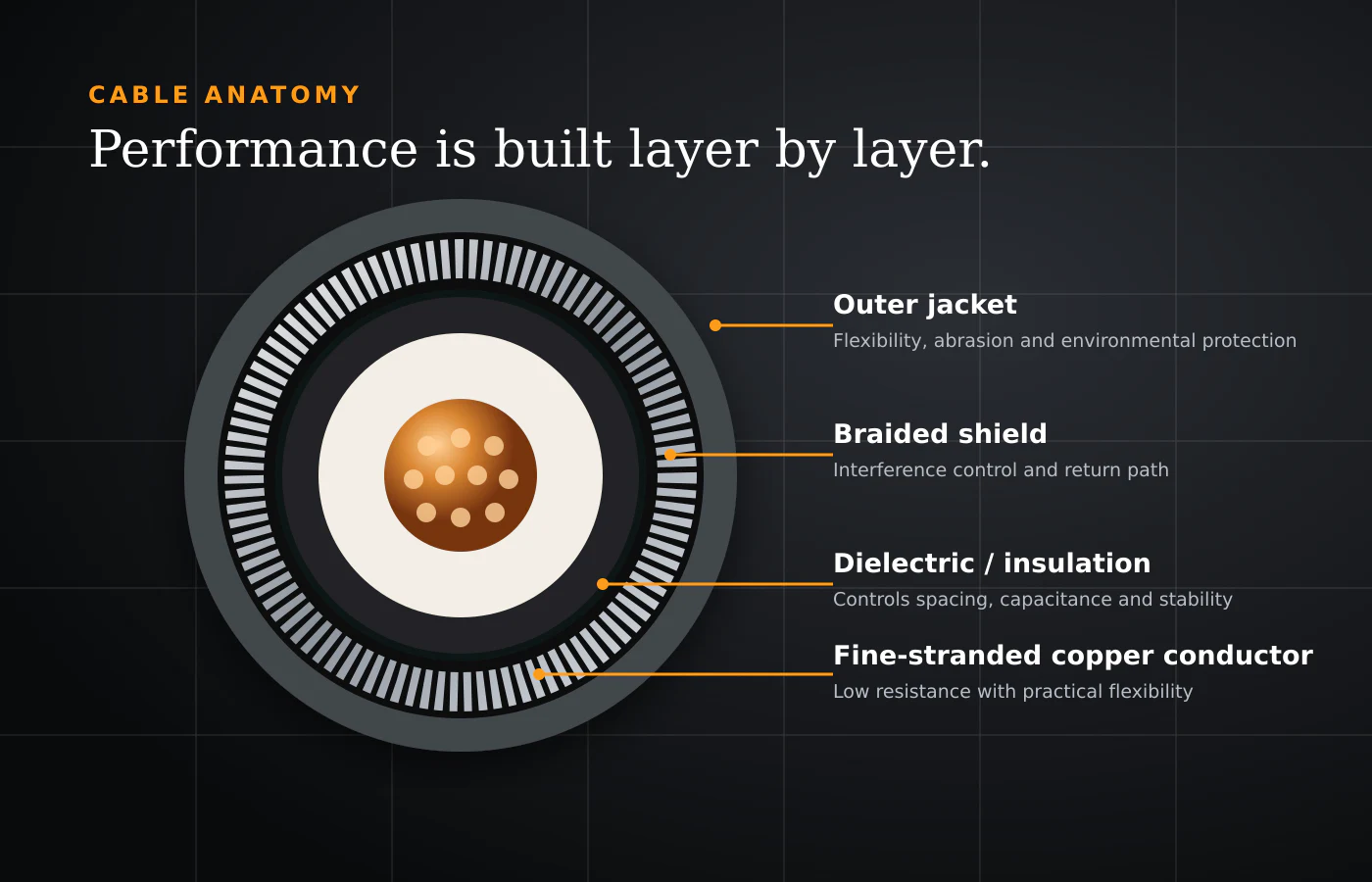
Noise rejection is a system property.
A balanced input responds to the voltage difference between two signal conductors and rejects voltage that arrives in common on both. Cable symmetry helps interference couple similarly into both legs; the receiving circuit’s common-mode rejection does the subtraction.
WBC-PRO-QUAD
Four conductors in star-quad geometry. Opposite conductors are paired for each signal leg, improving magnetic-field symmetry—especially useful around lighting, power distribution, stages and electrically hostile rooms.
Verified construction: 4 × 44 strands of 0.08 mm 99.99% OFC; 21-AWG quad configuration; 12.5 mm twist pitch; FPE insulation; >98% braided shield; 65 pF/m conductor-to-conductor.
Explore WBC-PRO-QUAD →WBC-PRO-QUAD-MINI
Star-quad noise-rejection geometry in a smaller, more flexible format for compact interconnects, portable rigs, desktop systems and tight cable paths. The advantage is practical density without abandoning a quad layout.
Choose it where connector size, bend radius and cable mass matter. As with any mini cable, route it without sharp kinks and protect small connectors from side load.
Explore WBC-PRO-QUAD-MINI →WBC-VALUELINE-2CS
A conventional two-conductor shielded balanced cable for microphones, line-level interconnects and active speakers. Its 22-AWG conductors and 18.3 pF/ft published capacitance make it a versatile everyday choice.
Star quad is valuable in strong magnetic interference, but a well-made twisted pair is the efficient answer for most normal balanced runs—and generally brings lower capacitance than quad geometries.
Explore WBC-VALUELINE-2CS →Balanced does not simply mean “two signals.”
The decisive condition is equal impedance from both signal conductors to ground, followed by a differential receiving input. A cable cannot make an unbalanced output balanced, and an XLR connector by itself does not prove the circuit is balanced.
For microphones and long line-level runs, check the source, destination and wiring—not just the plug shape.
Here, capacitance can become part of the tone circuit.
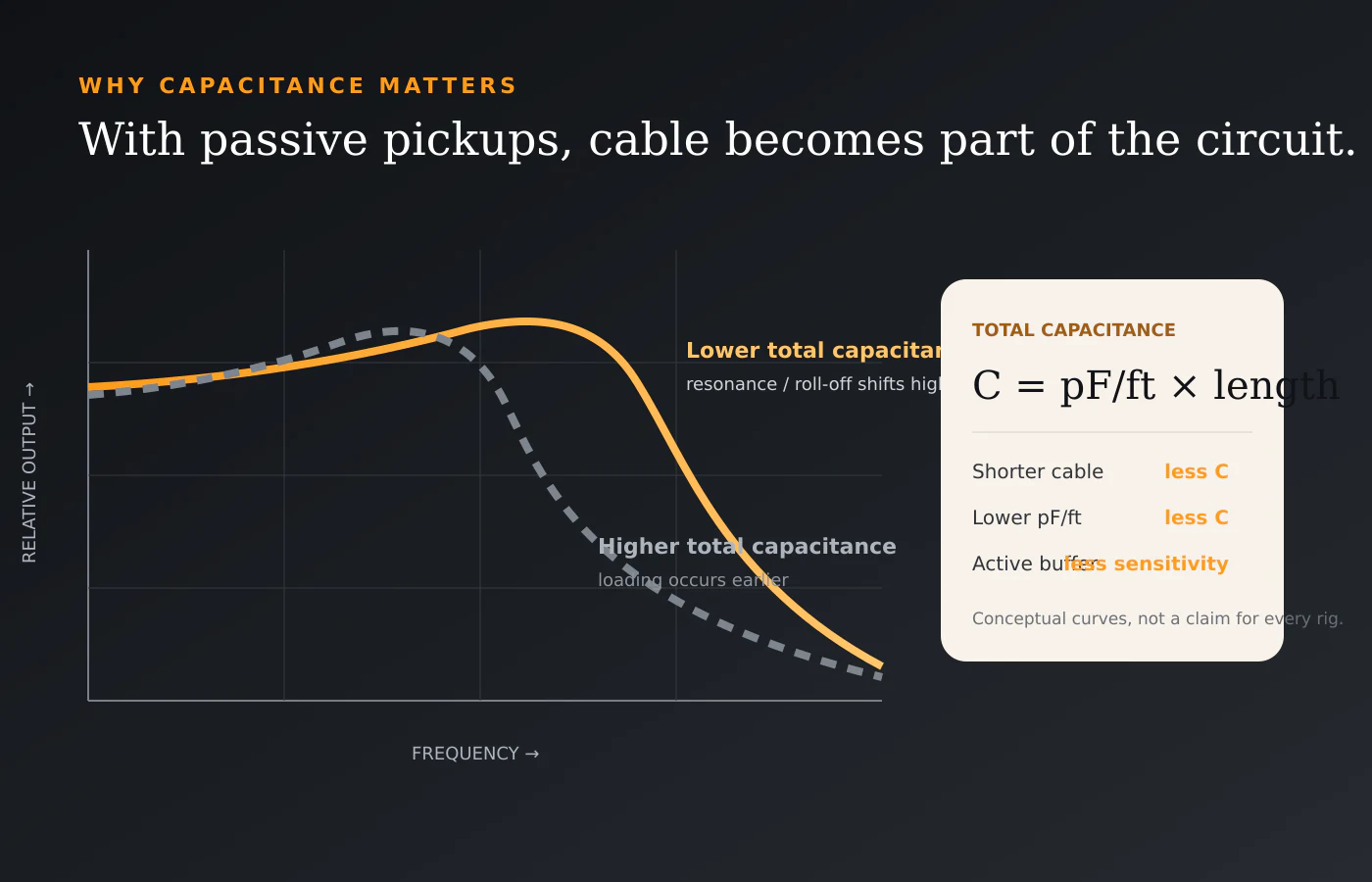
A passive guitar or bass pickup has far higher source impedance than a modern line output. Cable capacitance combines with the pickup’s inductance and resistance, changing the resonant peak and high-frequency response. Total capacitance is the cable’s pF-per-foot figure multiplied by length.
Lower capacitance does not mean “better tone” for every player—it means less cable loading and more of the pickup’s native upper-frequency response reaches the amp. A longer or higher-capacitance cable can sound intentionally softer. With an active instrument or buffer pedal, cable capacitance after the buffer has much less tonal influence.
WBC-PRO-GUITAR
A 20-AWG coaxial instrument cable with a 103 × 0.08 mm OFC center conductor, 18 pF/ft published capacitance, a >98% braided OFC shield and a graphite-based conductive PVC sub-shield. That second shield helps drain triboelectric charge created as the cable flexes—the mechanism behind handling crackle in lesser instrument cables.
View WBC-PRO-GUITAR ↗Many short patch leads still add up.
Six inches looks electrically insignificant—until a pedalboard contains twelve or twenty patch cables plus the guitar and amplifier leads. Before the first active buffer, every foot contributes capacitance. Mechanically, low-profile connectors also decide whether adjacent jacks remain usable and whether a neat board survives transport.
WBC-PRO-PEDAL
The WBC pedal cable uses a 22-AWG, 18 pF/ft construction with dual shielding: a dense OFC braided shield plus a graphite-based conductive PVC layer. It is designed for low handling noise, flexibility and tight routing.
The WBC-MINI-BOLT is the purpose-built ultra-small TS termination for high-density pedalboards. Its value is not decorative—it saves space, reduces connector overhang and helps control cable exit in crowded layouts.
Premium materials, disciplined geometry, explicit specifications.
WBC Ultimate assemblies add large conductors, very low published capacitance, custom or premium terminations, protective finishes and hand-applied presentation details. The engineering is visible; the audible result still depends on source impedance, length, environment and the equipment at both ends.
18-AWG ultra-low-capacitance coaxial
A 164 × 0.08 mm 99.99% OFC center conductor, published at 15 pF/ft, with a high-coverage shield and the custom WBC-RCA-SERIES-VI termination. Built for premium line-level and phono systems where low capacitance, robust conductor area and careful finish are desired.
View Ultimate RCA →Copper where current crosses the contact.
The center pin and grounding sleeve are machined from copper and plated with 99.99% silver. Components are precision CNC-machined; the outer shell is hard-anodized. Silver is highly conductive but soft, so these connectors are intended for careful home use—not daily stage abuse.
Good connector performance also depends on fit, contact pressure, cleanliness, strain relief and the solder joint—not plating alone.
Three 18-AWG conductors, 6.8 pF/ft.
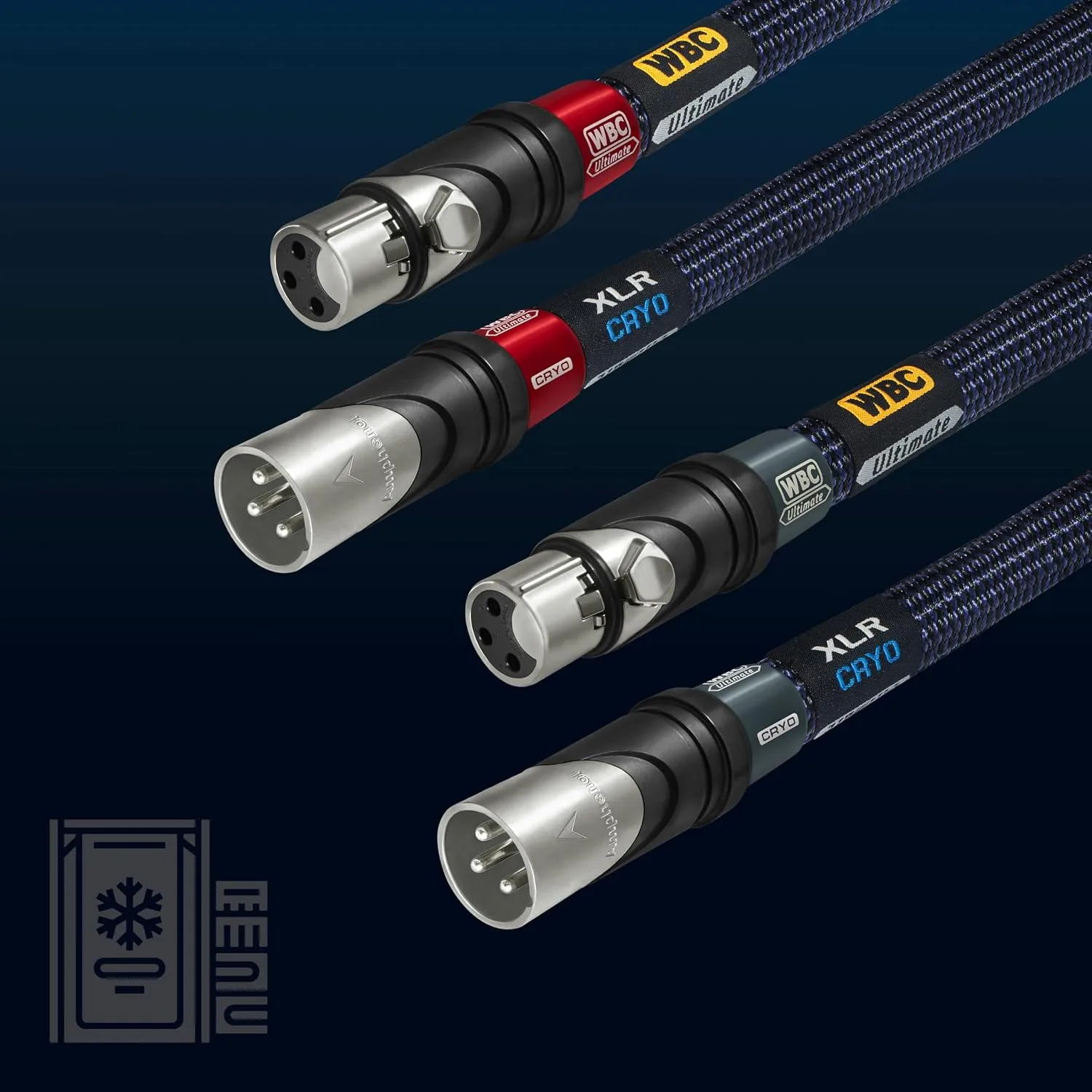
WBC’s Ultimate XLR uses a heavy triple-core 99.99% OFC cable with a published ultra-low 6.8 pF/ft capacitance. It is the premium non-cryo choice for balanced hi-fi and studio interconnects where large conductor area, low capacitance and luxury assembly matter.
View Ultimate XLR →The same measurable baseline, plus cryogenic treatment.
The cryogenically treated Ultimate XLR is offered for listeners who want that additional controlled manufacturing process. The most directly verifiable electrical benefits still come from the cable’s geometry, resistance, capacitance, shielding and termination.
Robust independent evidence has not established that cryogenic treatment of a finished copper audio cable is universally audible. WBC therefore presents it as a premium process—not a guarantee that every system or listener must hear a difference.
View Ultimate Revelation CRYO →Speaker cable carries current. Resistance leads the conversation.
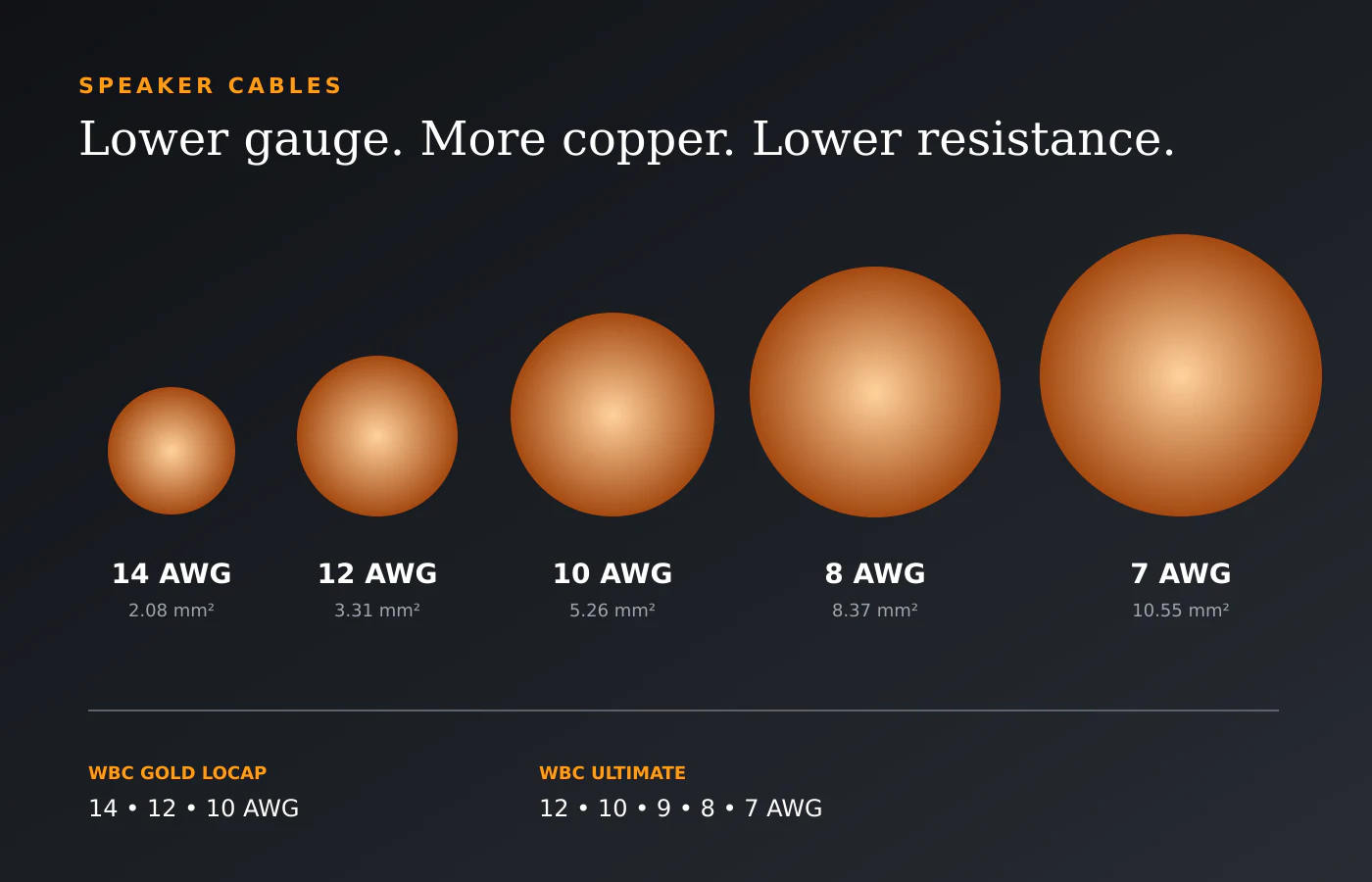
A speaker is a low, frequency-dependent load. Cable resistance is placed in series with it, slightly reducing voltage at the loudspeaker and lowering the amplifier’s effective damping. Thicker copper, shorter runs and sound terminations reduce that series resistance.
14, 12 and 10 AWG
High-purity OFC speaker cable engineered for low resistance with low-capacitance/low-inductance geometry. Choose 14 AWG for shorter, easy-to-route installations; 12 AWG as the all-rounder; and 10 AWG for longer runs, lower-impedance speakers or extra resistance margin.
12, 10, 9, 8 and 7 AWG
Large-gauge assemblies for listeners who want very low series resistance, premium terminations, substantial mechanical construction and a finished cable designed to complement high-end systems. Depending on model, standard, bi-wire and bi-amp configurations are available.
“It’s only ones and zeros” misses the physical layer.
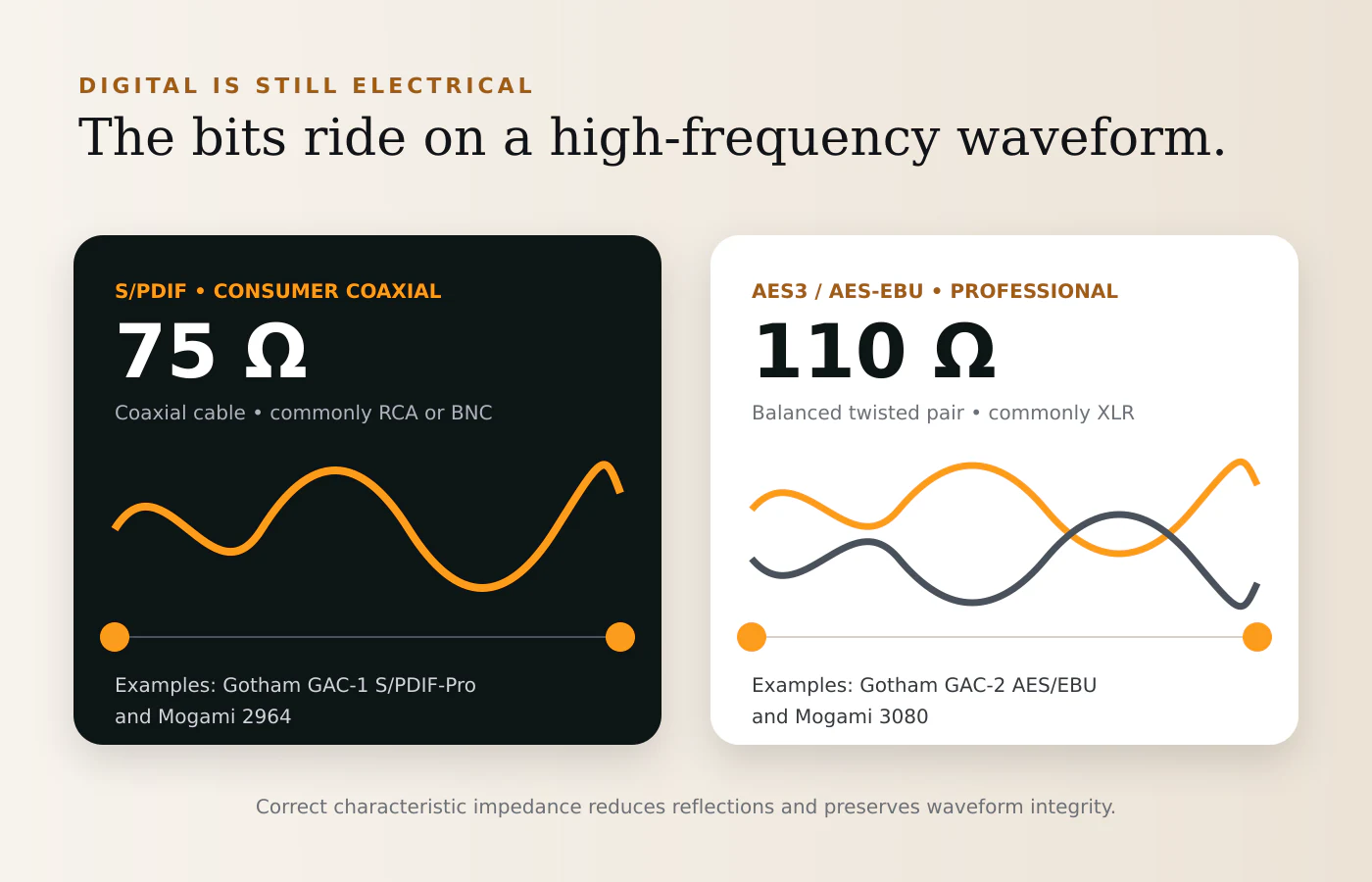
S/PDIF and AES3 carry encoded digital data as fast electrical transitions. At those edge rates, cable characteristic impedance matters. A mismatch can reflect energy back along the cable, deforming the waveform and reducing timing and noise margin. A compliant link does not make the recording “more digital”; it simply delivers a waveform the receiver can decode reliably.
75 Ω coaxial S/PDIF
WBC uses established third-party digital cable including Gotham GAC-1 S/PDIF-Pro and Mogami 2964. Both are purpose-made 75-ohm coaxial choices, typically terminated to RCA or BNC as the equipment requires.
110 Ω balanced AES/EBU
For professional AES3 connections, WBC offers assemblies using Gotham GAC-2 AES/EBU and Mogami 3080: controlled-impedance 110-ohm balanced cable normally terminated with XLR.
A connector is electrical, mechanical and human.
A good plug must maintain low and stable contact resistance, fit the mating jack correctly, resist corrosion, protect the solder joint from bending and remain serviceable after real use. Gold is valued for corrosion resistance; silver and copper offer high conductivity but demand appropriate handling and protection.
WBC assemblies use application-specific connectors from WBC and respected specialist manufacturers. WBC’s own MINI-BOLT solves pedalboard density. The RCA-SERIES-VI brings a copper signal path, silver plating and CNC-machined construction to carefully used audiophile systems.
Inside the shell, WBC uses a proprietary 4% silver solder blend and nitrogen-assisted soldering. Nitrogen reduces oxidation during soldering, supporting a clean, repeatable joint. Strain relief, conductor preparation and inspection remain just as important as solder composition.
What is measurable, what is contextual, and what deserves caution.
Resistance, capacitance, inductance and impedance
These are real electrical properties. Their importance changes with the circuit: capacitance is especially relevant to passive pickups, resistance to speakers, and characteristic impedance to digital links.
Shield coverage and cable geometry
Construction influences electric- and magnetic-field pickup. Balanced rejection also depends on the source and receiver; no cable can “cancel all EMI/RFI” in every environment.
More copper is useful—until resistance is already negligible
Larger speaker cable lowers resistance. Beyond the point where cable resistance is already a tiny part of the load, further audible improvement is system- and length-dependent rather than automatic.
Low capacitance is not a universal sound-quality score
It can materially change a passive guitar circuit. Between low-impedance line devices over a short distance, normal cable capacitance is usually far below any audibly relevant limit.
OFC purity is not the whole cable
WBC uses high-purity OFC for consistency, corrosion control and manufacturability. In ordinary lengths, geometry, conductor area, shielding and termination are more consequential than tiny conductivity differences among competent copper grades.
Cryogenic treatment and “break-in”
Cryogenic processing can be a controlled manufacturing choice, but universal audible benefit in finished copper audio cables is not established by strong independent evidence. Normal passive cable “break-in” likewise lacks a clear mechanism for large continuing sonic change.
Start with the signal—not the price tier.
| Your connection | Electrical priority | WBC starting point | When to step up |
|---|---|---|---|
| RCA line-level | Shielding, fit, sensible capacitance | WBC-PRO-LOCAP coaxial RCA | Ultimate RCA for premium construction, 18-AWG conductor and RCA-SERIES-VI. |
| Microphone / balanced XLR | Symmetry, shielding, flexibility | WBC-VALUELINE-2CS | WBC-PRO-QUAD in high-interference environments; Ultimate XLR for premium hi-fi/studio assembly. |
| Compact balanced / aux | Small diameter, flexibility, shielding | WBC-PRO-QUAD-MINI | Choose by connector format and available strain relief. |
| Passive guitar / bass | Total capacitance, handling noise | WBC-PRO-GUITAR | Shorten length or add a buffer when preserving maximum pickup bandwidth matters. |
| Pedalboard patch | Density, reliability, cumulative capacitance | WBC-PRO-PEDAL + MINI-BOLT | Use the shortest practical lengths and plan connector orientation before ordering. |
| Passive speaker | Low round-trip resistance, secure contacts | WBC GOLD LOCAP 14/12/10 AWG | WBC Ultimate 12–7 AWG for longer/lower-impedance runs and premium construction. |
| Coaxial S/PDIF | 75 Ω characteristic impedance | Gotham GAC-1 S/PDIF-Pro / Mogami 2964 | Choose RCA or BNC to match the equipment—do not adapt unnecessarily. |
| AES3 / AES-EBU | 110 Ω balanced characteristic impedance | Gotham GAC-2 AES/EBU / Mogami 3080 | Prioritize correct termination and cable integrity on long professional runs. |
Cable questions, without the fog.
Can an expensive cable improve a badly designed system?
No. Start with source quality, gain structure, grounding, room acoustics, loudspeaker placement and functioning equipment. A cable should solve the connection correctly and reliably; it cannot compensate for clipping, ground faults or poor acoustics.
Should every microphone cable be star quad?
No. Star quad is especially valuable where magnetic interference is a risk. A conventional balanced pair is excellent in normal environments and may offer lower capacitance, smaller diameter and lower cost.
Will a low-capacitance RCA cable always sound brighter?
Not between ordinary low-impedance line-level devices over short lengths. The capacitance effect becomes far more significant with high-impedance sources such as passive guitar pickups, or unusually long runs.
Is thicker speaker cable always audibly better?
Thicker cable lowers resistance. That is useful when the run is long, the speaker impedance is low or the existing cable is undersized. Once resistance is already a very small fraction of the loudspeaker load, additional gauge brings diminishing electrical returns.
Can I use an analog cable for S/PDIF or AES3?
It may work over a short distance, but digital interfaces are specified around characteristic impedance: 75 ohms for coaxial S/PDIF and 110 ohms for balanced AES3. A purpose-built cable preserves signal margin and avoids relying on luck.
What usually causes cable failure?
Repeated flexing at the connector, inadequate strain relief, contamination or wear at contacts, crushed cable, incorrect termination and poor soldering are common causes. Mechanical design and workmanship matter at least as much as the conductor material.